

You are preparing for Sunday, or sitting with your Bible before the house wakes up, and a question lands that you cannot answer from memory. Where does Scripture say that? So you open an AI assistant and ask. Seconds later, you have a confident paragraph and three references.
That is AI Bible study as most people meet it today: fast, fluent, and hard to check. It feels like help, and sometimes it is.
But a quiet question sits underneath every answer. Did the Bible actually say that, or did the machine say it for the Bible? If you teach, lead a group, or simply want to obey what God has spoken, that is not a small question.
This post gives you an honest answer. We will look at what people are really doing with AI and Scripture, where it fails, where it truly helps, and a simple test from the book of Acts that you can use every time.
Table of Contents
What Are People Actually Doing With AI and the Bible?
Start with the facts, because they are more balanced than the headlines. In September 2026, an NPR/Ipsos poll reported by Religion News Service asked 1,011 adults in the United States about AI and faith. Sixty-one percent said they had used an AI tool. Among those who had, 15% said they had used it to study Scripture, 13% had used it to generate prayers, and 11% had sought spiritual guidance from it.
The same poll found something just as telling. Nearly seven in ten of the people who use AI said they would never seek religious or spiritual guidance from it. So people are curious enough to study with it, and cautious enough not to be led by it.
Research from Barna, in partnership with Gloo, shows the same tension inside the church. In a survey of 1,514 adults in the United States taken in November 2025, 83% of practicing Christians said they worry about AI misinterpreting Scripture. Yet 34% of practicing Christians agreed that spiritual advice from AI is just as trustworthy as advice from a pastor.
Those are the numbers. What follows is how we read them. Believers are not being foolish. They are using a new tool the way they would use a concordance or a study guide, and they sense that there is a line somewhere. The work is finding where that line is.
Where Does AI Bible Study Go Wrong?
The first problem is the simplest one. AI can misquote the Bible. It can blend two verses into one, soften a hard word, or give you a reference that does not exist, all in a calm and confident voice.
This is not a fringe complaint. Bobby Gruenewald, the chief executive of YouVersion, said in remarks reported by the Christian Post in November 2025 that “the models misquote Scripture.” He put the inaccuracy at 15 percent of the time at best, and 40 or 50 percent at worst, and he called that unacceptable for a Bible that people need to trust.
Why does it happen? A language model does not look a verse up the way you do. It predicts the words that are likely to come next. Most of the time the likely words and the true words are the same, but when they are not, nothing in the answer warns you.
Scripture takes this seriously. “Every word of God is pure: he is a shield unto them that put their trust in him. Add thou not unto his words, lest he reprove thee, and thou be found a liar” (Proverbs 30:5-6, KJV). A misquoted verse is an added word, even when nobody meant harm.
The second problem is quieter. A fluent answer can replace the slow work of reading. Paul told Timothy to “study to shew thyself approved unto God, a workman that needeth not to be ashamed, rightly dividing the word of truth” (2 Timothy 2:15, KJV). A summary you did not wrestle with has not made you a workman. It has made you a reader of summaries.
The third problem is authority. A tool that can find passages will also, if you ask, tell you what to do about your marriage, your money, or your calling. That is counsel, and counsel belongs with the Word, the Holy Spirit, and the people God has placed around you.
What Can AI Honestly Help You With?
None of this means you should fear the tool. It means you should give it the right job, and this is where AI Bible study earns its place.
AI is good at finding. If you remember that a verse speaks about casting your care on God but cannot recall where it is, a search that understands meaning can point you to 1 Peter 5:7 faster than turning pages. It is good at gathering, because it can pull together passages on grief, courage, or forgiveness so that you read them side by side. And it is good at tidying, such as adding punctuation to notes you dictated in a hurry.
Notice what these three have in common. In each one, the AI brings you to the text or cleans up your own words. It does not stand between you and the text. You still open the passage, read it in its chapter, and hear it for yourself.
So the honest summary is this. Let AI be a finger pointing at the page. Do not let it become the page.
A Simple Test From Acts 17 for Every AI Answer
When Paul preached in Berea, Luke recorded how the people responded. “These were more noble than those in Thessalonica, in that they received the word with all readiness of mind, and searched the scriptures daily, whether those things were so” (Acts 17:11, KJV).
Think about that. An apostle was speaking, and they still checked. If Paul’s preaching was tested against Scripture, a chatbot’s answer certainly can be. Here is how to do it in four checks.
First, open the reference. Do not accept a quotation you have not seen in a Bible with your own eyes. If the verse does not say what the answer claimed, stop there.
Second, name the translation. “The Bible says” is not enough, because wording differs between versions. A trustworthy answer tells you whether it is quoting the KJV, the WEB, or another translation, so that you can compare it.
Third, read the neighbors. Read at least the paragraph before and the paragraph after. A verse lifted out of its setting can be quoted perfectly and still be used wrongly.
Fourth, bring it into the light. Share what you found with your pastor, your study group, or a mature believer. “Prove all things; hold fast that which is good” (1 Thessalonians 5:21, KJV) was written to a church, not to one person alone with a screen.
Four checks, and they take a few minutes. That is a small price for knowing that what you carry into Sunday, or into your own decisions, is truly the Word.
How VerseTap Handles AI and Scripture
We build VerseTap as a ministry tool, so these convictions had to become decisions inside the app. Here is what we chose, stated plainly so that you can hold us to it.
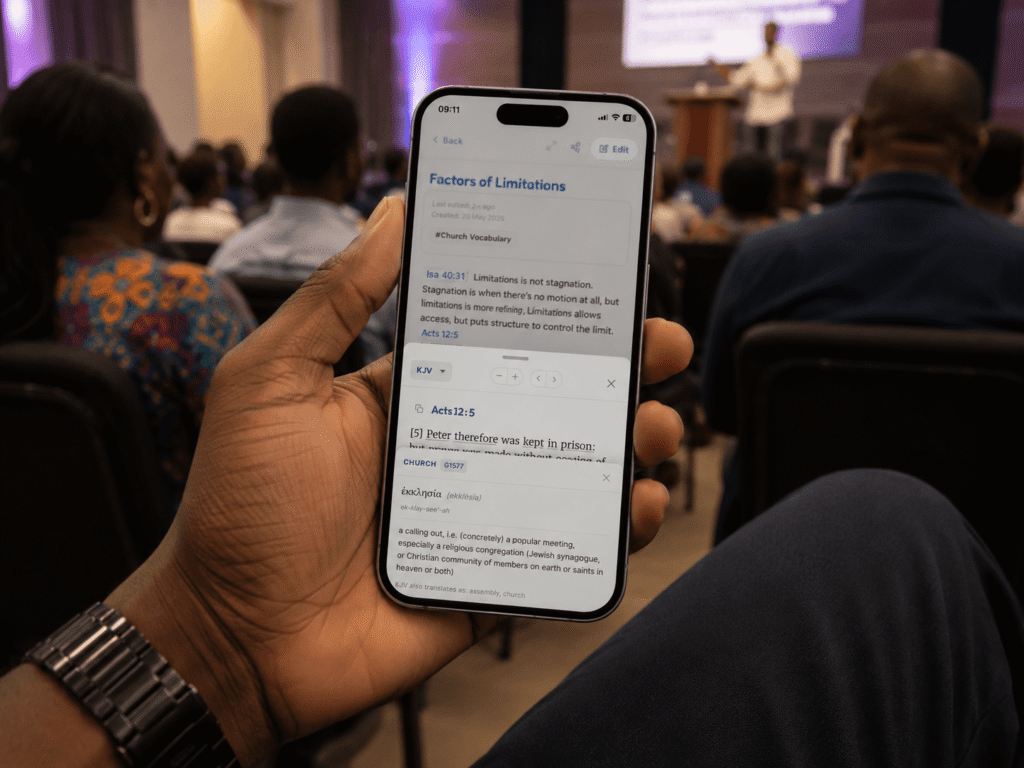
VerseTap does not write sermons. AI appears in a few small places, and each one is labeled. Scripture Counsel lets you type a life situation or a theme, such as fear, grief, or finances, and it returns passages sorted as promises, principles, prophecies, and stories. It gives you Scripture to read, not advice to follow.
In our latest release we tightened this further. Every AI answer in Scripture Counsel is now checked against the King James text, and any reference that does not exist is dropped before you see it. The words on each card are the verse itself, with the version named beside it, for example, “Psalm 23:1 (KJV).” Our eleven hand-picked themes go one step further, because each key verse is one whole KJV verse, word for word, and those themes work without internet.
Two other features use AI, and both now say so on the screen. One tidies notes you dictated, and one helps you find a reference from a phrase you remember. These features need a connection, and the text they need passes through our server to Google Gemini and is not stored by VerseTap. Your notes themselves are never stored on VerseTap servers.
The Bible inside VerseTap is not generated at all. It is five translations kept on your device (KJV, WEB, BSB, ASV, and YLT), which is why a verse reads the same today as it will next year. You can read more about that choice in our post on public domain Bible translations, and about the wider field in our guide to AI tools for sermon preparation.
We will not claim that this makes AI Bible study safe to follow without checking. It does not. It makes the checking easier, and it keeps the Scripture in front of you.
Frequently Asked Questions
Is it wrong for a Christian to use AI Bible study tools?
No. A tool is not sinful in itself, and believers have long used helps such as concordances and commentaries. The question is whether the tool brings you to Scripture or replaces your reading of it. Use it to find and gather passages, then read them yourself.
Can AI misquote the Bible?
Yes. General AI models predict likely words, so they can blend verses, change wording, or cite references that do not exist. The chief executive of YouVersion has said publicly that the models misquote Scripture 15 percent of the time at best. Always open the reference in a real Bible.
What is the safest way to use AI for Bible study?
Use the four checks drawn from Acts 17:11. Open the reference, name the translation, read the surrounding passage, and talk it over with other believers. Prefer tools that show you the verse from a real translation and tell you which one it is.
Does VerseTap use AI to explain what the Bible means?
Scripture Counsel returns passages for a theme, each with a short note on why it was suggested, and it is labeled as AI. The verse itself comes from the King James Version and is checked before it is shown. VerseTap does not write sermons or give personal advice.
So, can you trust AI Bible study? Trust it to point. Do not trust it to speak for God. The Bereans were called noble for one habit: they received the word eagerly, and then they checked.
Here is one thing to practice this week. The next time any tool, app, or person hands you a verse, open it, read the whole chapter, and write down in your own words what it says. If you want help with that habit, our guide on how to take better sermon notes is a good place to begin.
“Thy word is a lamp unto my feet, and a light unto my path” (Psalm 119:105, KJV). The lamp has not changed. Tools will come and go, and some of them will be useful, but the light you walk by is the same Word that believers before you walked by.
If you would like a place where your Bible and your notes sit together, with Scripture you can check in one tap, VerseTap is free on Google Play, the App Store, and at versetap.ng. Tap the Verse. Feel the Life.
About the author
Simeon Taiwo Oluwafimijoba is a minister, church administrator, and Bible teacher, and the founder of VerseTap, a Bible study and sermon note-taking app built in Port Harcourt, Nigeria.